Tuesday, March 23, 2010

Those Elgin Pugs!

Do you guys remember the ValenPug party I went to last month? I met lots of pugs (and their people) at the party like Gen and the Foo, and Rainy. It was so cool to meet these pugs that I had been talking to for months. Mom calls it putting a face with a name. Um, okay. I already knew what they looked like so I'm calling it putting a smell with a face. Makes perfect sense to me!

I also met some new pugs at the party. I didn't get everypug's name but I spent a lot of time with one pug family in particular. Josie, Izzy, & Anakin along with their parents Katy and Rob drove a long way to get to the ValenPug party and I'm sure glad they did. All us pugs hit it off right away but Josie and I formed a special bond because we are both slow movers. Over this past month I've been emailed Josie and we've gotten to know each other pretty good so this past Sunday I paid her a visit.

When Josie met me outside I couldn't believe my eyes. She was a true vision of beauty. She got all dressed up and even took a bath in preparation for my arrival. I was suppose to get my nose cleaned but somehow I managed to get out of it. Josie didn't mind because she told me she likes stinky pugs.

Josie is a recycled pug. She came to her forever family from Northern Illinois Pug Rescue and Adoption. Even though she's blind and deaf, she still has many years left in her. Isn't she pretty?

I played a little hard to get when I first got to Josie's house. I didn't want her to think that I was a total pushover (which I am) or that I was easy (which I'm not) so I just hung out with Dad while Josie chilled out.

Josie digs me because I'm totally her speed - slow. She has trouble getting around but since she's been on her meds, she's been getting around a lot better. I'm still refusing my meds despite some tricks with cheese that Dad has tried. My sniffer is way too good to be fooled. I may be old but I can still smell medicine!

Of course I had to make the rounds and get pets from everyone. I think Josie's dad Rob approved of me because he gave me lots of pets.

When it came time to go outside for a potty break, Josie had to take her dress off. It snowed here on Saturday and even though most of the snow had melted, it was very muddy. I asked Mom to get a couple more pictures of Josie in her pretty dress before we headed to the backyard.

Once we came back inside, we hung out some more. I hung out with Josie's brothers too and this good looking guy is Anakin. He used to live in a barn! Can you believe that someone would put a pug in a barn to live? He's lucky he didn't freeze to death poor guy. I just found out today that he has a crush on a certain pug who lives in Virginia. I can't tell you who it is but her name begins with a S. Yikes! I think I spilled the beans!

I had lots of fun hanging out with Anakin. He's a very cool pug and he approves of me dating his sister.

This is Izzy. I call her Crazy Izzy because she couldn't sit still. She's eight years old but has the energy of an eight month old puppy. I think she was a little jealous of my relationship with Josie because we got into a little tiff. Everything turned out fine between us but I told her that I'm a one puggy kind of guy.

Josie is just like me and can't jump up on the furniture. Unlike me, Josie is content to sit on the floor. I must always be on a lap because I need to be on people. I must be touching people most of the time or I'm a mess. A hot mess as Mom likes to say.

Izzy had to be contained by her dad because she was getting a little too excited. At one point I barked because I saw someone ride by on a bicycle and Izzy snapped at me. I think she was going for my cute little pug nose but luckily her mom caught her just in time. She's definitely the boss of the house and I think she was just trying to keep me in line.

I did not have to be contained. I just had to be on Dad's lap for most of the visit. I don't like a lot of crazy running around and I feel safe when Dad is holding me. Mom says I'm getting to be a big baby in my old age but Dad saying I'm turning into a COP - Cranky Old Pug. Whatever!

Josie decided she wanted to be at Stubby level so her dad picked her up and put her on the sofa next to me. She was totally digging me!

I didn't want to overstay my visit, plus I was getting tired, so Dad told me it was time to leave. I would have stayed longer but I didn't want to miss dinner at home and I knew Mom would not approve of us going through the drive-thru at Popeyes. Josie's dad held us for one last photo I like to call 'The Cute Couple'.

In between hanging out, Mom showed Josie's mom how to start a blog. After we left, all the pugs and people worked on the blog and then emailed me the link. Yeah! Another pug blogger! Please visit Josie, Anakin and Izzy at their blog Those Elgin Pugs. They've been reading some of your blogs for the past month and can't wait to meet you!

I had such a great time visiting with Josie that I can't wait until we can get together again. I don't know when that will be but soon (hopefully) the weather will stay nice and we can play outside. I'm even going to invite Josie to my house so we can play in my yard and maybe even go to Popeyes. I know you might think that Popeyes is not an appropriate place to take a date but believe me, if Stubby loves Popeyes then Josie does too!

Monday, March 22, 2010

World Water Day

World Water Day is held annually on 22 March as a means of focusing attention on the importance of freshwater and advocating for the sustainable management of freshwater resources. Water is the most important resource we have, thus the term "Blue Gold". It is up to us to do whatever we can to ensure clean drinking water for today and for the future.

Clean water is a privilege and not a right for many people around the world. Americans, like most people in the developed world, simply take it for granted. You know that when you go to the sink and turn on the water knob, clean water will flow, and flow, and flow. This may be the way it is today, but there is a serious water crisis and it may one day affect you personally, so take nothing for granted.

So how did World Water Day begin? According to the World Water Day website, the international observance of World Water Day is an initiative that grew out of the 1992 United Nations Conference on Environment and Development (UNCED) in Rio de Janeiro. The UN designated March 22 of each year as the World Day for Water by adopting a resolution and invited countries from the globe to devote the day to the conservation and development of water resources, thereby raising awareness of the global water crisis.

The goals of World Water Day are to raise awareness about sustaining healthy ecosystems and human well-being through addressing the increasing water quality challenges in water management, and to raise the profile of water quality by encouraging governments, organizations, communities, and individuals around the world to actively engage in proactively addressing water quality e.g. in pollution prevention, clean up and restoration. Pretty lofty goals? Heck no! Totally attainable goals if we all work together to make them happen.


This year's theme is "Clean Water for a Healthy World". Millions of people around the world do not have access to clean water. Hard to believe, isn't it? When I say millions of people I mean nearly 900 million people. Yikes! That means almost one out of every 6 people lacks clean water. I bet you didn't know that lack of clean water is the second largest killer of children under the age of five.
Please check out http://www.waterday.org/ for more information on World Water Day. We are all in this together and we can make a difference.

Saturday, March 20, 2010

Saving Trees?

Mom bought this magazine the other day for Dad to take on his trip. Dad usually likes to watch movies on the plane but he had already seen the movie and wanted something to read. Dad loves to cook and loves anything Food Network. I love to eat and love anything Dad makes so I was happy Mom bought this magazine.

Mom had to flip through the magazine before giving it to Dad because she is a magazine freak. She loves them; loves all printed media for crying out love. Mom cooks but since she doesn't eat most food that other people and pugs eat, she was only looking through the magazine for cool gadgets. I couldn't believe my ears when I heard her scream out in terror as she got to the end of the magazine. I thought that maybe there was a recipe for turtle soup or pug chili but it wasn't either of those it was this:

Can you guys read it?

OMP! Mom was all over this! How could a magazine that is not even printed on recycled paper have an advertisement for recycling magazines? Of course everyone should recycle magazines - duh! Common sense, right? Think again. After I got Mom to calm down, I did some research into this ad to see what it was all about.

A couple of years ago the Magazine Publishers of America (MPA) ran a campaign to get people to recycle their magazines once they were through reading them. Great idea! Most curbside recycling programs accept magazines yet according MPA, but most people are not awareness of this so they launched the campaign to raise awareness. According to the MPA website, only about 20 percent of magazines are recycled from the home, even though at least two-thirds of the population has access to magazine recycling in their community. Increasing the number of magazines for recycling means reducing the amount of virgin fiber that must be obtain to create printed materials. Sounds great, right? Yes and no.


This logo was suppose to appear in all publications whose publishers are members of MPA. Guess what? This logo was nowhere to be found in the Food Network magazine. The logo can usually be found on the magazine information page near the front of the magazine but it was curiously absent. Mom flipped through page after page of recipes, food ads, product ads, and of course the obligatory medicine ads but never saw the logo. How hypocritical of Hearst Magazines, publisher of Food Network magazine, to not have this logo in their magazine after selling a full page ad about recycling magazines. Shame on them! But there's more to the story.

MPA claims that recycled magazines are not generally suitable for making new magazine paper. WHAT?! Instead, old magazines are commonly used in production of newsprint and tissue products, and also may be used, along with other types of fiber, to manufacture boxboard, and even writing and printing paper. Mom was furious when she read this. It's the old do as I say and not as I do. Who do the magazine publishers think they are?

Since there are two sides to every story, I decided to investigate Hearst Corporation first to see if they have green initiatives. They have a 'being green' section of their website dedicated to informing consumers about their commitment to a greener world. I had high hopes that what I would find on their website would help me see they are committed to doing the right thing, but I was wary that I would find the outcome I desired.

According to the Hearst Corporation website, in July 2007, all Hearst magazines began carrying the recycling logo. Really? Was it only for 2007? When and why did they stop? I didn't find the answers to these questions but I did find out a lot about their position on the issue of recycled content.

"Hearst is currently using 15% post-consumer recycled paper (PCR) across it's portfolio of publications, primarily in the newsprint we buy. After extensive review, we currently believe newspapers and other end uses (packaging, wallboard, etc.) are the most efficient use for recycled fiber, which continues to be in short supply.

Clearly, the industry can and will recover more paper for reuse. But critics who call for magazine companies to use higher levels of recycled content in magazines should consider that:

Demand outstrips supply, limiting the availability of recycled fiber. Virtually all recovered fiber is being used.

Asia has significantly increased its paper manufacturing capacity, leading to increased demand for recovered fiber from North America.

It is important to use recycled fiber, but we most do so efficiently to avoid creating a negative carbon footprint.

Thus, the insufficient supply of recovered fiber makes recycling and and supporting sustainable forestry key goals for the magazine industry and for Hearst."

Now we're getting somewhere! If I'm hearing what Mom is reading to me correctly, the bottom line, according to Hearst, is that there isn't enough recycled fiber for their portfolio. Hmmm. What about printing just a few magazines, like Food Network, on 100% PCR? Or maybe printing all April magazines on 100% PCR in honor of Earth Day? There must be a viable solution to the recycled content problem.

Hearst does support sustainable forestry and 100% of the paper they purchase is tracked for sustainability. Purchasing virgin fiber from non-sustainable sources is a definite no-no and Hearst has worked to increase its certified purchased fiber from 38% in 2004 to 70% in 2008 (these were the latest figures available). They work with a third party auditor to ensure their forestry practices are up to snuff and they also require the paper mills they use to be use a third party certification "Chain of Custody". This makes me feel a whole lot better.

Hearst Magazines launched TheDailyGreen.com in 2007 to provide consumers with a website dedicated to green living. Those of you who follow Mom on Twitter know that she frequently retweets a lot of their tweets. The site has lots of great content for seasoned as well as newbie greenies.

Whew! I was so tired after researching Hearst but Mom pushed me to research what others had to say about the magazine industry. What better place to look then Green America? They did a study a few years ago that concluded:

"The magazine industry is a significant contributor to deforestation, dioxin contamination, air pollution (including greenhouse gases) and water pollution. Environmental damage caused by this industry will escalate unless publishers increase their use of recycled-content paper. In its study of the industry, the PAPER Project found:

Magazine production contributes extensively to deforestation.

Less than 5% of magazine paper has any recycled content, and even these recycled content papers generally contain only 10-30% recycled fiber.

The vast majority of magazines are discarded within one year, and few of these are recycled.

Overproduction compounds the industry's impact. The magazine industry's impact on the environment is compounded by systems that reward the industry for overproduction of publications.

Almost 3 billion magazines on newsstands are never read.

I've spared you from the details for each point because this post is already too long. If you are interested in the nitty-gritty, you can check it out here.

So what does all of this mean? Should everyone stop purchasing magazines? This is not a good solution for everyone. Though Mom loves magazines, she has greatly lessened her magazine buying addiction in favor of reading them at the library. Our library subscribes to lots of magazines and those that our library doesn't have, another library close to us does. We are lucky to live in a community that supports its library system. If you haven't been to the library lately, you should check it out because most have lots to offer besides books.

Should you only purchase magazines made from recycled content? Bingo! Why should magazine publishing be different from any other industry? I understand what Hearst says about recycled content not being available but there are magazines that are printed using 100% PCR. You just have to look for them. And read them. And even purchase them because doing so shows you are supporting their commitment to recycled content.

Both Mom and I understand Hearst's commitment to sustainable forestry and while this is commendable, is there really such a thing as sustainable forestry? This is just like sustainable fisheries and you know where we stand on that issue. We are in the same camp as Green America and believe that magazine publishers must increased their use of recycled content. Not doing so shows less of a commitment to the environmental than sustainable forestry.

At the end of the day, the advertisement is just that - an advertisement. A paid page in a magazine. Why would this ad be in this particular magazine? Apparently it's all about marketing and demographics. Readers of this magazine are probably users of ebay. And I have to say that the cause they are marketing is a great one. Recycling has been and will continue to be one of three main issues Mom and I are committed to (garbage and clean water are the others). I never did a post on RecycleBank even though I started one over a year ago. It's a great program that pays you to recycle. I'm all about getting more people to recycle even if it takes giving them money to do so.

Thursday, March 18, 2010

Where Does Your Milk Come From?

Do you guys drink milk? If you do, have you ever wondered where it came from? I'm not talking about where as in from cows but where as in the location of the cows.

Believe it or not the only milk I've ever had came from my biological mother. Mom doesn't give me milk because she says I don't need it. Huh? I don't need it but Dad does? Why is that? Mom refused to answer these questions and I didn't want to ask Puglet's friend Google. I really don't care so much about the fact that I can't have milk as much as I care about where Dad's milk comes from so I decided to check it out.

While Mom was out shopping today she picked up some milk. Dad recently started drinking Oberweis milk and he loves it. It comes in cool glass bottles and they will even deliver it to your door just like in the old days. Oberweis has been in business since 1927 and according to their website, people love the milk because of its taste. Apparently the glass bottles keep the milk cold and protect the flavor. This is what their website says about the cows and milk:

Let's start at the beginning…We purchase milk from family-owned dairy farms which pride themselves on superior quality. The dairy cows on their farms are not treated with synthetic rBGH hormones* and our farmers are paid a premium based on the measurable quality of the milk they produce.

Tankers pick up milk daily from our farms and deliver to our dairy plant where the milk is pasteurized, homogenized and bottled in half-gallon glass bottles. When you return your bottles to our store, we then wash, sterilize and re-use our bottles rather than contribute to the problem of overflowing landfills.

I'm all about keeping garbage out of landfills and since the bottles are returned to the place of purchase for a deposit, the only thing that gets recycled are the caps (they go to Aveda). Of course Oberweis cost more than regular grocery store milk. Mom paid $3.50 plus $1.50 for the bottle deposit. Yikes! I guess that's just the price you have to pay for premium milk.

So I know that Oberweis is premium milk but where do it's cows come from? The website only said they purchase their milk from family-owned dairy farms, but where are those located? So many questions. Luckily for me I found a website that may have the answers to my questions.

Do you see those numbers on the cap? The best by date is on top and right below is 10821 and a time. Those numbers must mean something right? To find out where the cows that made Dad's milk came from, all I have to do is enter the numbers into http://www.whereismymilkfrom.com/. So simple even a pug could do it. Or so I thought.

I logged on to the where is my milk from website. The site explains how to read the numbers on the bottle and they provide lots of examples. The first part of the code is the state code and everything after that is the plant code. The state codes are always two digits and the plant codes can be one to five numbers or letters. My code is 10821 and since I know Oberweis is local (based in Aurora, IL), I'm assuming their cows are local too. All I have to do is put the code into the milk carton on the site and I will find out where Dad's cows come from. Right!

I entered 10821 and it came up invalid. 10 is the state code for Delaware, but 821 is an invalid plant code. Hmmm. I then tried 1082 and the same thing happened. What is going on? I looked around the website to see if there was another way I could locate my cows. I found a section called dairies, clicked on Illinois and found Oberweis. Their code is 17-61. What? Then I looked closer at the cap and noticed in very small teeny print "Plant #17-61". So then what is 10821? I was very confused so I decided to try another dairy product.

The site works with most dairy products so I decided to try Dad's creamer. He drinks coffee several times a week and he likes it with half-and-half. Surely this creamer would have a code that would tell me where it's cows came from.

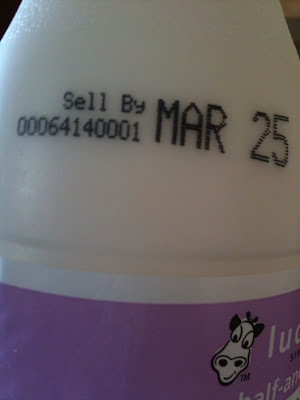
Yikes! What a strange looking code. The first code I tried was 6414 but of course both the state and plant code were invalid. Then I tried 06414 and the state code 06 was correct (California) but the plant code was invalid. What is going on? There wasn't anything printed on the cap so I searched the label and sure enough, written in teeny print was "Plant 55-184". Guess where these cows live? Wisconsin, the dairy state! Dean Foods of WI - Golden Guernsey in Waukesha to be exact. Just up the road about 60 miles north of us are the cows that make Dad's cream.

But why does the website only show examples of codes on the bottles and caps and not on the labels? Good question. I'm emailing them tonight to give them my feedback. Not everypug is as smart as me and can figure things out, so I think they need to add additional information to the website. Printing codes on products is voluntary so not all dairy products will have codes. Some codes will not even be codes so it's best to look over the entire product before entering codes. I learned this the hard way even though it says this on the website. Ugh!

I thought this whole experience would clear some things up about the milk and creamer that Dad uses. The creamer label says "processed and packaged at plant 55-184" but doesn't mention the cows. Could it be that the cows don't live there? Maybe they live in another state and their milk is trucked to 55-184 to be pasturized, homogenized and packaged in bottles just like the Oberweis milk. Maybe the same cows that make Dad's milk make his cream. Who knows. I'm more confused now than when I started this project. Please check out where your milk comes from and let me know your results, that is if you get any.

Monday, March 15, 2010

Great News About Paper Recycling

I could hardly contain myself when I hear the great news about paper recycling the other day. I started my happy dance before Mom could even finish reading me the news. Hooray! I couldn't help it. Great recycling news makes me dance!

We recycle all the paper we can. I always hear Mom saying to Dad "That can be recycled" when he goes near the garbage can. Is this a case of old habits dying hard or just a lack of knowledge on Dad's part? Hmmm. I'm guessing the former because if anyone knows about recycling it's Dad. Years of listening to Mom talk recycling, reusing, reducing, precycling, etc. have impacted him in a good way. He is more conscious of what he throws in the garbage and this makes Mom and I very happy.

Now for the great news. The American Forest & Paper Association reports that in 2008, a record high 57.4% of the paper consumed in the U.S. was recovered for recycling. How cool is that? People are really starting to take action in this arena. Paper that would otherwise end up in landfills is turning up in recycling bins all over the country. So how much is 57.4% of the paper consumed? Would you believe that amounts to 340 pounds of paper recycled for every person in America? Yikes! Thinking about you guys consuming that much paper makes me shudder. Why are you consuming so much?

Not only are we making great strides with paper recycling but we're doing it big. 57.4% is up from 56% in 2007 and 53% in 2006. According to paperrecycles.org, the paper industry hopes to recover 60% of the paper Americans consume by 2012. Lofty goal or totally doable? I say totally doable, but only if everyone does their part. PIAC states that 86% of Americans have access to curbside or drop-off paper recycling programs. If you don't have access to either, please ask a friend that has access to recycle your paper.

Paper recovery rates have risen almost every year since 1993. I'm not sure what happened in 1997, 1999, 2002, and 2004 when they didn't rise, but these slight decreases were met with increases the following year.

But what happens to all the paper we recycle? According to the Paper Industry Association Council (PIAC), two-thirds of it is used domestically, with containerboard accounting for the largest end-use with 31%. This domestic usage is great to hear because shipped anything overseas leaves creates a big carbon footprint. Not that using it domestically is carbon neutral but we need to recover and use all that we can on our shores in order to keep the footprint as low as possible.

PIAC also adds that in 2008, over 80% of cardboard containers were recovered for recycling. There aren't many reasons why cardboard can't be recycled. As long as it isn't wet from liquids or stained from food (think pizza boxes) it can go in the recycling bin. Mom hates it that most pizza boxes end up in landfills because they can be added to compost bins.

The global recession has affected paper recycling just like every other business. There was a sharp decline in demand for recycled paper which resulted in decreases in consumption and overall tons recovered. Whose to say what the long term impact of the slowdowns will be as the economy rebounds.

The message here is, as it always is with recyclables, is to close the loop. We must create the demand by purchasing recycled content paper goods. The higher the post-consumer content the better. We must also seek out items that contain recycled content where previously only virgin content was used. I'm talking about books, magazines, etc. We can even encourage manufacturers to use recycled content. We speak volumes with our shopping dollars aka the Big Green Purse.

It's our responsibility to get to 60% by 2012. Will you do your part to make it happen?

Thursday, March 11, 2010

The True Cost of Stuff

Those of you that have been reading my blog for a while now remember my post about The Story of Stuff by Annie Leonard. Leonard's 20 minute film documents production and consumption of the stuff we use. The Story of Stuff is now a book because there's just so much stuff!

Leonard wrote a very cool article for the Huffington Post the other day about externalized costs and after Mom read it to me I knew I had to share it with you. Mom is obsessed about stuff like Leonard and this article totally made me think that Mom could have written it. If you don't know what externalized costs are keep reading. And even if you do know what they are keep reading. It's important to remember that nothing comes cheap. There's a greater cost to almost everthing we purchase even if we don't realize it. We must understand these costs and what they are doing to the world. My world, your world, everyone's world. We're all in this together.
------------------------------------------------------------------------------------------------

The Story of Stuff: Externalized Costs and the $4.99 Radio
by Annie Leonard

Walking to work one day I wanted to listen to the news, so I popped into Radio Shack. I found a cute little green radio for $4.99. Pleased with my bargain, I stood in line to pay, but then started wondering: how could $4.99 cover the cost of extracting the raw materials, manufacturing the parts, assembling the radio, and getting it into my hands?

Whenever I go to buy something I get sidetracked, thinking of how it got here. It's an occupational hazard. I spent a decade traveling around the world, visiting the factories where our stuff is made and the dumps where it goes when we don't want it any more. What I learned makes it impossible for me to look at anything and not see the journey it made through the global take-make-waste system.

The metal in that $4.99 radio was probably mined in Africa. The petroleum that went into the plastic probably was pumped from Iraq, and the plastic itself produced in China. The packaging came from forests in Brazil or Canada. Maybe the parts were then shipped across the ocean to Mexico, where some 15-year-old in a maquiladora assembled the radio. There it was put on a truck or a train and shipped to a distribution center in Southern California, then 500 miles north to my local store.

Four-ninety-nine? That wouldn't pay for the shelf space it took up until I came along, let alone the salary for the guy who helped me pick it out.

That's when I realized: I didn't pay for the radio. So who did?

A study currently underway for the United Nations is calculating the cost of pollution and other environmental damage caused by the 3,000 largest publicly held corporations in the world. The study, which will be published this summer, has found that the cost of environmental damage by these companies is $2.2 trillion, or more than one-third of their profits if they were held financially accountable. This includes greenhouse gas emissions, other pollution, and water degradation. The final amount is likely to increase once additional costs -- like toxic waste -- are incorporated.

The Guardian newspaper wrote: "The report comes amid growing concern that no one is made to pay for most of the use, loss and damage of the environment, which is reaching crisis proportions in the form of pollution and the rapid loss of freshwater, fisheries and fertile soils." Economists call that externalizing costs, and it's how corporations hide the true cost of making and selling cheap stuff -- costs that are never recorded on the balance sheets and consumers never see. As David Korten writes in When Corporations Rule the World, "Externalized costs don't go away -- they are simply ignored by those who benefit from making the decisions that result in others incurring them."

What the UN report means is that a big chunk of the profits these big companies are making is due not paying the full cost of extraction, production, distribution and disposal. They are shoving a whole range of costs -- from pollution to climate change to water depletion -- onto us. Communities around the world are bearing the costs with degraded health, soil, water and climate change. That's just not fair.

Which takes us back to the original question: Who paid for that $4.99 radio? Some people paid with the loss of their natural resources. Some paid with the loss of clean air, with increased asthma and cancer rates. Some workers paid by having to cover their own health insurance. Kids in Africa paid with their future: a third of the school-age children in parts of the Congo now drop out to mine metals for electronics. All along the way, people pitched in, or were forced to, so I could buy a radio for $4.99 -- so cheap that if it broke I could just throw it away.

The UN report is a good first step at showing the global scale of externalized costs. If we're going to get our economy and environment back in order, a top priority must be forcing companies to pay the full costs of production. In economist-speak, this means internalizing externalities. That would be a strong motivator to get companies to invest in the cleaner, less polluting approaches and encourage all of us to avoid superfluous consumption.

If the true cost of that cotton t-shirt or iPod was included in the price tag, we might think twice before throwing it out and replacing it before we really need to. Think about that next time you look at those insanely low prices on so much consumer stuff -- who is really paying the full cost of producing all this? Not the companies that sell it.

Sunday, March 7, 2010

Recycle Your Old Jeans

Mom was wearing an old pair of jeans yesterday that had a huge rip in the thigh area. I don't know why she doesn't just fix the jeans but she loves them so much that she wears them even though look icky. She hates for anything to end up in a landfill and as much as she'd like to, she just doesn't have it in her to turn the ripped jeans into a cool purse. Lucky for her I found just the solution to give her jeans another life and to get a brand new pair.

The Gap has teamed up with Cotton Incorporated's From Blue to Green denim drive which started back in 2006 as part of Cotton's Dirty Laundry Tour. Now through March 14, you can bring your icky looking, ripped up jeans to the Gap and they will be recycled into insulation. How cool is that? The insulation is then donated to communities in need through Habitat For Humanity. Almost 200 houses have been insulated with UltraTouch, the insulation created from recycled jeans thus far.
When you drop off your jeans at the Gap, not only will they be turned into insulation but you will also receive 30% off a new pair. The Gap website states that recycled denim will only be accepted at stores with recycle bins at the cash wrap and that you must present the coupon in order to receive the discount. Turn in your jeans, get your coupon, and go shopping. And I know I don't have to mention it but I will - please don't forget to bring your reusable bag to the store. Since you'll be bringing at least one pair of jeans, they will probably be in a bag that can be reused but if you are just carrying your jeans in your hands, please refuse a new bag from the store. Mom remembers the days when it seemed like everyone in the mall would be carrying a blue plastic Gap bag - yuk! Where do you think those bags are today? I shudder to think how many are in landfills.

I'm sending Mom to the Gap tomorrow with her icky jeans. She can't go today because I need a warm body to sleep next to. I'm feeling much better today and thank all of you for your well wishes. I'm so lucky to have so many great friends that care about me.

Friday, March 5, 2010

I'm Okay

Mom is convinced that I'm sick. She thinks that I haven't been feeling very good all week and there's talk that I might have to go to the vet. I told her that I'm fine but she's just not buying it.

Does this look like the face of a sick pug to you? Of course not! Just because I prefer to lounge around all day doesn't mean I'm sick.

Another reason Mom thinks I'm sick is because I'm having problems with my folds. If you look real close, you can see that my right fold is much darker than the left one. Maybe you need a closer look.

Hmm. I think it looks fine, a little brown but generally good. Mom keeps rubbing my fold and you wouldn't believe the stuff that comes out of it.

From this angle you'd never know that there is bunny poop in my fold. How did it get there? Well, the bunnies visit my backyard and go poopy. Lots of little bunny pellets litter the snow covered grass. The pellets call my name and I run around the yard gobbling them up. Delicious!

All that poopy also makes my nose dirty, or so Mom thinks. It's not really dirty it's planned eating. I keep the poopy on my nose in case I get hungry once I come in the house. I'm much smarter than Mom thinks.
This is a super close up of my totally cute and not dirty nose. Having access to instant food keeps me from starving when Dad is gone for the day or out of town.

I've decided to give Mom the funky face so that my fold is crooked and looks less dirty.

Does it look like it's working? I didn't think so.

Mom thought maybe Buddy Dog could make me feel better but I didn't want anything to do with him. I didn't even want him to be in a picture with me but I didn't have the energy to kick him off the sofa.

"I'm not looking at you Buddy. You are invisible to me. Get out of my face before I turn into devil dog!"

I convinced Mom that having some lunch would make me feel better. She agreed and told me she would share her lunch with me. I was excited about eating until I saw what she was having for lunch - yuk! I was thinking more along the lines of a burger, some fried chicken, or a cheese sandwich but of course Mom doesn't eat any of those things. I know my pal Tuni loves broccoli so it's too bad she wasn't around because there was no way I was eating any of that stuff. I did have some of the tofu but it just didn't hit the spot.

Since Dad was gone for the day and the veggie queen wasn't going to break out any real food for me, I decided the best thing to do was go back to sleep. Wake me when the cows come home!

Wednesday, March 3, 2010

Wednesday Wag Out!

Whipped Cream Tray

I thought of my sexy friend Penny when I found this cool tray. She loves whipped cream and what could be better than having whipped cream on a whipped cream tray?

This tray is made from reclaimed whipped cream cans. How cool is that? Each tray is one of a kind and is sure to be a conversation starter no matter where you use it. Mom thinks it would look great on the dining room table holding some soy candles. Hmmm, is that a Mother's Day gift hint?

Check out this cool tray and all the cool earth friendly items at www.bibelotshops.com

Skateboard Bangle Bracelet

Believe it or not, back in the day Mom used to skateboard. This was way before my time but I asked her what ever happened to her skateboard. She had no idea where it was and I told her it was probably in a landfill as I slapped her on her hand.

These cool bracelets are made from skateboards that were destined for the landfill. A Philadelphia artist saves the skateboards and turns them into a very hip, stylish accessory. Some people are just so creative!

Roll on over to http://www.homeandplanet.com/ to get your own one of a kind bracelet.

Recycled Umbrella

Mom still uses a rickety old umbrella that's probably from the 1980's, but I think I found an umbrella that she will love and have to have.

This handmade umbrella is made from non recyclable plastic garbage that is collected from various places in Indonesia. The garbage is triple washed and then sewn into an umbrella. Wow!

The company that makes them, Monsoon Vermont, was started by a woman who developed sustainable businesses in developing countries. She had seen similar items in boutiques in the UK but after a trip to Indonesia after the devasting tsumani in 2004, the proverbial light bulb went off and Monsoon Vermont was born.

Turning trash to treasure has never seemed so beautiful before so get your umbrella at http://www.themonsoongroup.com/ before it rains on your parade.

Tuesday, March 2, 2010

Helping Honey Bees

You guys know I have a sweet spot (pun intended) for honey bees. They are one of natures greatest workers and their livelyhood is seriously theatened by Colony Collapse Disorder (CCD). Without honey bees humans would have to find manual ways to pollinate plants at costs that could rise into the billions very quickly. Thankfully, by spreading the news about the honey bees people are starting to take action to ensure these little guys are with us a very long time. Some companies are even geting involved in the cause because what's good for the honey bees is good for business.

Did you know that one of out every three bites of food an average American eats is directly attributed to honey bee pollination? Wow! We need honey bees more than they need us or so we used to think. Prior to the rise of CCD, honey bees had been doing what they'd always done - pollinate flowering plants like strawberries, peanuts, and mangos. Almonds are 100% dependent on honey bees for pollination and are even shipped to almond orchards in California each spring to pollinate millions of trees.

But what does Haagen Dazs have to do with honey bees? Everything! More than 50% of the ingredients used in their ice cream come from plants pollinated by honey bees. No honey bees means no ice cream. And even though I don't eat ice cream, many people love it and couldn't imagine life without it. So we have to save honey bees in order to save ice cream.


Back to Haagen-Dazs. How are they helping honey bees? In 2008 they partnered with Penn State University and the University of California at Davis to help with research, outreach, and student training. Private companies helping public universities with research initiatives is not new. This much needed funding not only helps the cause but also spreads the word about programs that benefit the greater good.

How can you help? Learn all you can about honey bees and Colony Collapse Disorder. Scientists are still trying to figure out what causes CCD while working tirelessly to stop it before it's too late. Extinction of the honey bee is not something anyone wants but it could soon become a reality.

You can also help the cause by creating a bee friendly garden. We always have lots of bees in our garden and even though Mom yells at me to leave them alone when I try to play with them, I know they won't hurt me because they are my friends. Haagen-Dazs has instructions on planting your own garden here.


You can also eat ice cream! Haagen-Dazs Vanilla Honey Bee ice cream was created to honor the honey bees that make so many foods possible. By purchasing this ice cream you are helping fund the research that will hopefully save the bees.

Haagen-Dazs also has a cool tool on their site to make a bee. It's not a real bee but a special Haagen-Dazs bee that you can email to your friends. You can create your own special bee by selecting its hair, head, eyes, mouth, body, and collar. (Note: I tried to make and send a bee and it didn't work. I'm going to try again later, but if you successfully make and send one please leave me a comment.)


Mom doesn't really eat ice cream but she loves honey bees as much as I do. She doesn't know what she would do if they disappeared and neither do I. With your help, we can save the honey bee. A world without honey bees would not be a sweet world. Please do your part to keep these guys pollinating the world. Catch the buzz at http://www.helpthehoneybees.com/.